

Bintan tourism
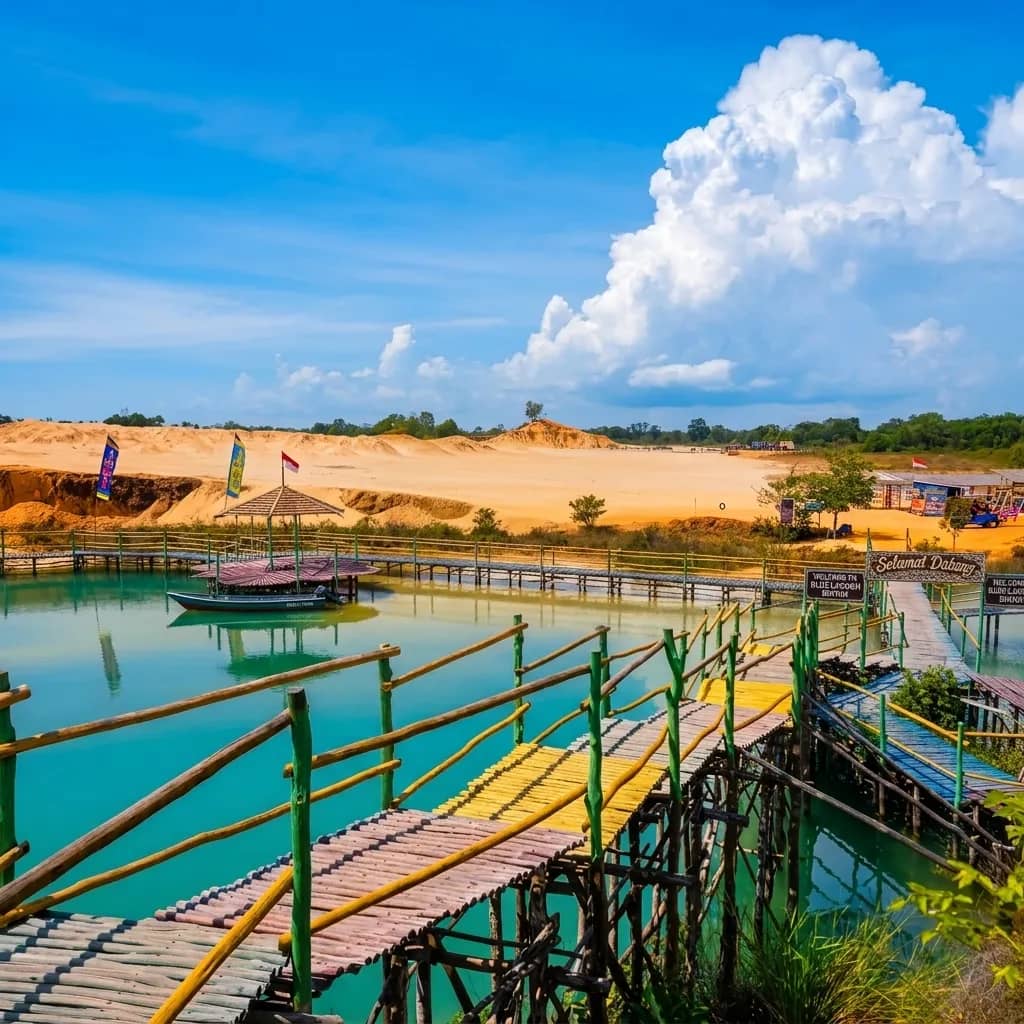
Telaga Biru Bintan: The Turquoise Lake at Busung
The colour is real, but it does not appear at every hour or in every month, and what you are looking at is a flooded quarry, not a lake. Forty minutes on the bank is about right for this place — usually as the second half of a morning that begins on the sand flats next door.
What Telaga Biru actually is
Telaga Biru is in Busung village, Seri Kuala Lobam district, on the north-west side of Bintan — and it is the same quarry as Gurun Pasir. Quartz sand was mined here for years; once the digging stopped, the pits filled with rainwater and groundwater, leaving a cluster of lakes ringed by white sand banks. The sand flats have their own page on this site and the water has this one, because visitors arrive with two different questions.
The colour comes from the minerals once mined here. Fine particles of quartz and clay hang in water that is actually clear and reflect the light back as that turquoise. So the colour depends as much on what is above the water as on what is in it: under a high sun it is at its richest, under cloud it fades to a grey-green, and through the dry season, as the lakes shrink, it turns paler. Photos from here are generally not exaggerated — but nearly all of them were taken during the same two or three hours.
One thing to be clear about before you go: this is a stop, not a full-day destination. Half an hour to an hour on the bank is what almost everyone does. There is no shade, no changing room, no shelter from the rain, and no food beyond whichever warung happens to be open that week. And nobody should go into the water — the reason is in the notes below, and it is not a formality.
Location, when staff are on site, and how long to stay
Four figures worth having before you set out — including one that is usually left out: how long you will actually spend there.
Drive time
30 minutes from Lagoi
55 minutes from Tanjung Pinang
Visiting hours
08:00–18:00, daily
The area is open ground with no gate, so this is when the fee table and the warung stalls are actually there — not opening and closing times. After dark there is no lighting at all, including on the access road.
Length of visit
30–60 minutes
Enough time to walk along the bank, take photos and sit for a while. It is also why hardly anyone comes here on its own: Gurun Pasir, a few minutes away, is the other half of the morning.
District
Seri Kuala Lobam
Address: Jl. Raya Busung, Busung, Seri Kuala Lobam, Kabupaten Bintan, Kepulauan Riau 29152
Open in Google Maps
When the colour really shows
This is the only place on the island where the best time and the most comfortable time are not the same, and it is better to say so plainly. The turquoise needs a high sun. You do not.
Most comfortable, softer colour
7am – 9.30am
The air is still cool, the water calm and the surface flat enough to mirror the banks — a photo in itself, and the only time you will have the place almost to yourself. What you will not get is postcard turquoise: at a low angle the light reflects off the surface rather than entering the water, so it looks blue-grey and green. Come at this time if you have children in the car, or if you are combining it with Gurun Pasir next door.
Best colour, toughest conditions
10am – 2pm
The sun is high enough to shine into the water rather than bounce off it, and this is when the photos you have seen were taken. It is also open white ground on the equator without a scrap of shade — hot, glaring and hard going for anyone without water and a hat. If that trade-off is what you want, keep it to half an hour and be honest about who is in the car with you.
The middle ground
3.30pm – 6pm
The heat eases, the colour lasts longer than you might expect, and towards five the light warms and the western banks catch the sunset. Busier than the morning. After 6pm there is nothing to see and no lighting to see it by, so head back before the light goes, not as it goes.
What there is to see at Telaga Biru
Not ranked best to worst, but in the order you walk the bank, from where the cars stop to the far side. All five are enjoyed from dry land — and this page means that literally.
The main lake
The big pool in all the photos
The largest of the old quarry pits, and the one people mean by Telaga Biru: a broad expanse of water enclosed by white banks, with scrub on the far side and not a single building in the frame. Its size and colour both change through the year — widest and richest after the rainy season, shrinking and paling towards the end of the dry season. It is a two-minute walk from where the cars stop.
Good for: Everyone; especially for photos
The ridge above the water
The spot where the photos you have seen are taken
A mound of packed sand on the near side, high enough to fit the whole lake and the far bank into one frame. This is the viewpoint in almost every photo of the place, and at weekends there is a queue. The climb is short, but the surface is loose and the edge is undercut in places — stand well back from where the edge looks solid, and hold on to small children.
Good for: Photos; keep children away from the edge
The white sand banks
Quarry spoil that looks like a beach but is not
The mounds and slopes of quartz sand around the water, left where heavy machinery once pushed them. They are exactly what makes the colour stand out — a turquoise pool against grey ground looks nothing like one against white — and they are also the most misunderstood part of the site. This is not a beach: the sand is loose, the slopes are steeper than they look in photos, and they drop straight into deep water.
Good for: Walking along the top, not down
The smaller lakes behind
Three or four more, each a different colour
Behind and beside the main lake are several smaller pits, and the extra five minutes to reach them is worth it because no two are the same colour: depth, mineral content and how thick the scrub is at the edge all change the colour reflected back. At any hour they are quieter than the main lake, which is another reason to walk round. The tracks between them are soft sand and no place for a low car.
Good for: Those with half an hour, not ten minutes
The west bank at sunset
The last half hour, with light sweeping across the water
Because the site faces north-west with nothing in the way, the last of the sun comes in low across the water and lights the banks from the side. It is the best half hour of an afternoon visit and the reason not to leave at five. The catch is the same as at Gurun Pasir: once it is dark there is no lighting on site or on the access road, so remember exactly where the car is parked.
Good for: Afternoon visitors who can stay until dark
Addresses, hours and drive times were compiled in September 2026 from the site's Google Maps listing, the Dinas Pariwisata Kabupaten Bintan destination list, and our drivers' trip logs from both Lagoi and Tanjung Pinang. All figures are estimates, and drive times vary with traffic. This page does not list parking or entry fees: they are cash, collected on site by whoever is on duty that day, and the amounts change. Nor does it give the depth or size of the water — this is a former quarry whose bottom nobody has ever measured and whose edges are still shifting, so any figure here would just be someone's guess repeated.
The sand flats are part of the same site
Gurun Pasir Bintan is the ground that was dug out to form this lake, just a few minutes along the same road. Most guests do both as one morning, and that page answers the questions this one does not: what an hour on open white sand is like, and what time to go.
What to know before you go
Stay out of the water
This is the most important one. The bank drops steeply into water nobody has ever measured, the bottom is mud rather than sand, the deeper water is cold beneath a warm surface, and there are no lifeguards or fences. People drown in old quarries that look exactly like this. Take your photos from dry land.
Bring water, a hat and small notes
There is no shade and no restaurant; the nearest warung is on the main Busung road, and the vendors on site may not be there when you arrive. Parking and the entry fee are cash only, there is no ATM nearby, and small notes save any argument.
Mind the edge of the banks, especially with children
The white banks are piles of quarry spoil, not a beach: in places they are undercut and the surface can collapse. The photo everyone takes is from the top of exactly that kind of ridge. Stand a metre back from where you think it is safe.
Check the sky before you give up a morning
On a cloudy day the turquoise simply does not appear — the colour relies on direct light entering the water. Rain itself is not the problem, just as at Gurun Pasir next door, where it actually firms up the sand; here it is the cloud that costs you, because the colour is the reason you came.
We will drive you to Busung and wait until you are done
Tell us the date, how many of you there are and where to pick you up. We will have a car ready with a driver who knows the turn-off from the Busung road — and who can combine Gurun Pasir or the Bandar Bentan Telani ferry terminal into the same route.