

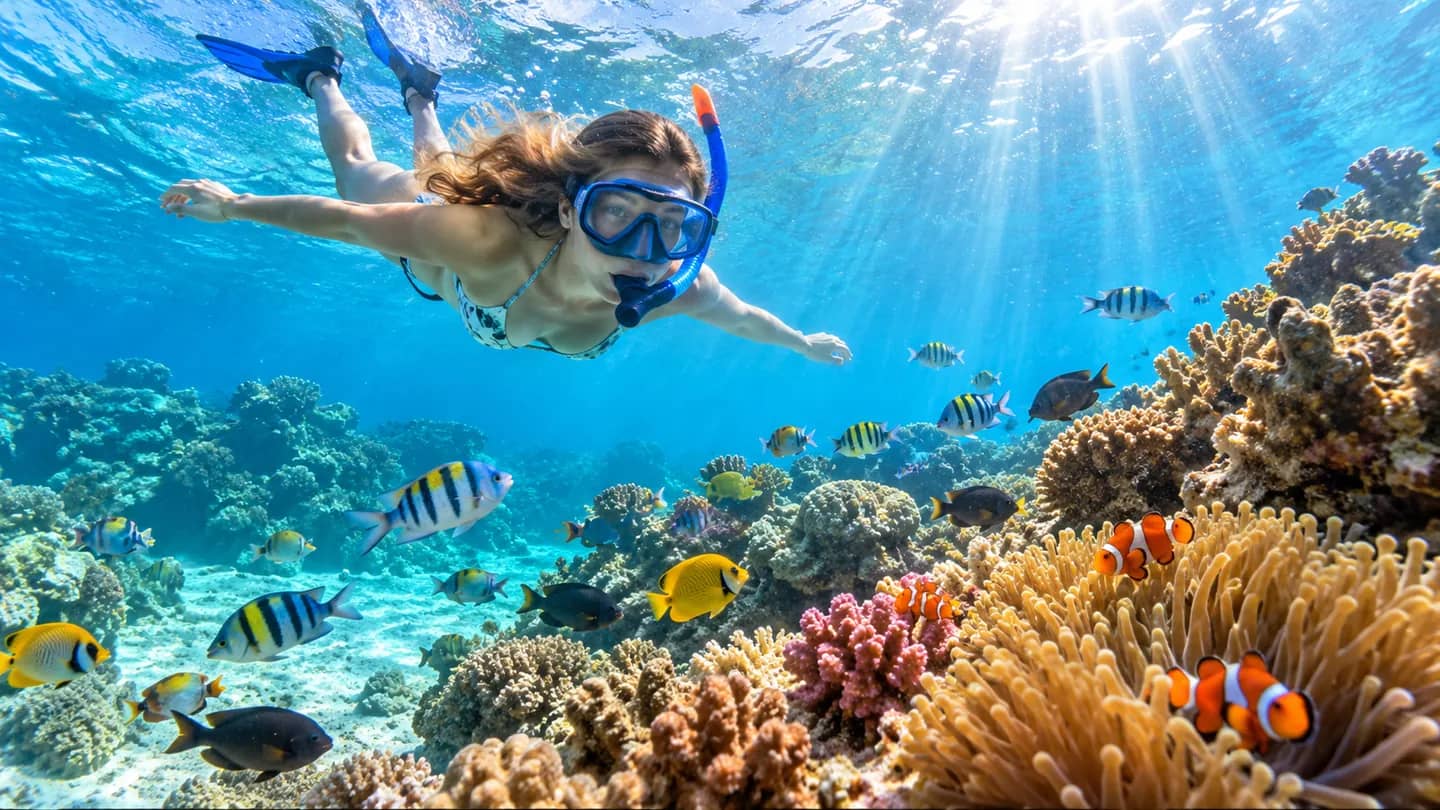
Bintan tourism
Snorkelling in Bintan: The 5 Best Spots and the Best Months to Go
The reefs are not in front of the hotels — they are all on the east and north coasts; two can be entered straight from the beach and the other three need a boat. Here are all five, nearest to Lagoi first, along with the months when the water is clear.
What to know about Bintan's waters before you go
Bintan is not Raja Ampat, and you should not expect it to be. What you will find here is fringing reef and stretches of seagrass in shallow water — mostly one to four metres deep, with small reef fish, starfish and gong-gong clearly visible. The more intact coral and clearer water are around the small islands off the east coast, and getting there means taking a boat.
The Lagoi resort area in the north is, in fact, not the place for it: the seabed is sandy and muddy, and the beaches were built for swimming, not for looking at coral. So almost every spot below is a 30- to 75-minute drive from Lagoi, towards Pengudang in the north or Trikora and Kawal in the east — and no public transport serves any of them.
One thing matters more than which spot you choose: the month. Bintan is exposed to the northeast monsoon, and at its peak the waves build on the east coast, the sand is churned up and the usually clear water turns murky. Boats to the islands often do not sail either. The timing windows are set out below — read them before choosing a spot.
The best months for snorkelling in Bintan
It is the monsoon wind that decides, not the rainfall. Afternoon showers fall on Bintan all year round and do not spoil snorkelling; what does is the northeast wind stirring up the seabed.
Best window
April – October
Calm seas, the clearest water, and boats to Beralas Pasir, Dendang and Mapur running almost every day. Ideal from morning until around 11am, before the midday wind picks up. May to September is the most settled period.
Northeast monsoon season
November – March
Waves build on the east coast and visibility drops sharply; boats to Pulau Mapur are often cancelled on windy days. Pengudang on the north coast is the most sheltered and is usually still possible. If you are visiting in these months, have a back-up plan on land.
Five snorkelling spots on Bintan Island
Sorted by total travel time from Lagoi, nearest first — not ranked from best to worst, because the spot that suits a strong swimmer with a full day is not the answer for a family with young children and a single afternoon.
Pantai Pengudang
The nearest seagrass beds to Lagoi, shallow and calm
Getting in: From the beach
- District: Teluk Sebong
- From Lagoi: 30 min drive
- Depth: 1–3 m
On the north coast at Pengudang village, and the only spot on this list you can do as a half-day trip from Lagoi. The seabed is a broad seagrass meadow with fringing coral in between — not dramatic reef scenery, but the water is shallow, calm and the most sheltered from the northeast wind, making it the most sensible spot for children and for first-time snorkellers. These waters are also a seagrass and dugong conservation area; dugongs are rarely seen, but starfish, young turtles and small reef fish are almost always there.
What you will see
- Seagrass meadow
- Starfish
- Small reef fish
- Gong-gong
- Dugong conservation area
Getting there
About a 30-minute drive northeast of the Lagoi resort area via Sebong. Entry is from the village beach; there is no official ticket, but there is usually a parking fee. The seabed is rocky in places — wear water shoes.
Teluk Sebong, Kabupaten Bintan, Kepulauan Riau
Open in Google MapsPantai Trikora 4
Snorkelling from the beach on the east coast, no boat needed
Getting in: From the beach
- District: Gunung Kijang
- From Lagoi: 60 min drive
- Depth: 1–4 m
Trikora is a long stretch of coastline on Bintan's east side, divided into Trikora 1 to 4, and the fourth is the one most used for snorkelling: large granite boulders, clear water between them, and fringing coral starting a few dozen metres from the sand. It is also the departure point for boats to the offshore islands, so many guests use it as a base — one session from the beach first, then a boat to Beralas Pasir or Dendang for the second. There are warungs and gear rental along the beach.
What you will see
- Fringing coral
- Clownfish and butterflyfish
- Sea urchins — do not step on them
- Large granite boulders along the shore
Getting there
About an hour from Lagoi via the east coast road, or 45 minutes from Tanjung Pinang. There is no public transport out here. Some of the beach entrances charge an entry fee.
Gunung Kijang, Kabupaten Bintan, Kepulauan Riau
Open in Google MapsPulau Beralas Pasir
A white sand island with coral right off the beach
Getting in: By boat
- District: Gunung Kijang
- From Lagoi: 60 min drive
- Boat: 20 min from Pantai Trikora 4
- Depth: 2–6 m
A small white sand island off Trikora, and the most popular stop on island-hopping trips from there. The draw is that the coral is right off the beach — you walk in from the sand and within ten metres you are over the reef, in two to six metres of water that is far clearer than along the main coastline. Part of the island is occupied by a small resort, so it is best to check with the boat owner which part of the beach day visitors can use.
What you will see
- Fringing coral right off the beach
- Clear water, 2–6 m deep
- A wide variety of reef fish
- White sand to rest on between sessions
Getting there
An hour's drive from Lagoi to Trikora 4, then a 20-minute boat ride chartered on the beach. There is no fresh water and no warung for day visitors — bring your own drinking water and food.
Gunung Kijang, Kabupaten Bintan, Kepulauan Riau
Open in Google MapsPulau Dendang
Deeper coral, combined with island hopping
Getting in: By boat
- District: Bintan Pesisir
- From Lagoi: 60 min drive
- Boat: 30 min from Pantai Trikora 4
- Depth: 2–8 m
An uninhabited island off Trikora, usually combined with Beralas Pasir on the same boat charter. The coral is deeper and more extensive than at the two beach spots above — two to eight metres, with denser coral fields — and this is the first spot on the list that genuinely feels like snorkelling over a reef rather than a sandy bottom. There is nothing at all on the island: no buildings, no water and no shelter other than the trees.
What you will see
- Coral fields at 2–8 m
- Medium-sized reef fish
- An uninhabited island
- Can be combined with Beralas Pasir on one boat
Getting there
An hour's drive from Lagoi to Trikora 4, then a boat ride of about 30 minutes. Because the island is uninhabited, agree the pickup time before you get off and make sure there are life jackets on the boat.
Bintan Pesisir, Kabupaten Bintan, Kepulauan Riau
Open in Google MapsPulau Mapur
The best coral around Bintan, and the furthest away
Getting in: By boat
- District: Bintan Pesisir
- From Lagoi: 75 min drive
- Boat: 60–90 min from Kawal
- Depth: 3–12 m
A fishing island in the open sea east of Bintan, and the real reason divers come out this way. It has the most intact coral and the clearest water of all five, at depths of three to twelve metres, with several sites that are also used for diving. The trade-off is clear: the crossing takes an hour to an hour and a half across open sea, the waves are bigger, and the trip takes up a full day. Not a spot for hesitant swimmers, and not one for the northeast monsoon season.
What you will see
- The most intact coral around Bintan
- The best visibility in the calm season
- 3–12 m deep, some sites used for diving
- A fishing village on the island
Getting there
About a 75-minute drive from Lagoi to Kawal, then 60 to 90 minutes by boat to the island. The boat charter must be arranged the day before, and the trip can be cancelled at short notice if the wind is strong.
Bintan Pesisir, Kabupaten Bintan, Kepulauan Riau
Open in Google Maps
Depths, boat times and travel times were compiled in September 2026 from the Dinas Pariwisata Kabupaten Bintan destination list, each location's Google Maps entry, and the trip sheets of boat operators at Trikora and Kawal. All of them are estimates and change with the tide and the weather. This page gives no visibility figure: around Bintan it ranges from well over ten metres to under two, depending on the month and the tide, so the seasonal windows above are more useful than a single number. Boat prices are not listed either — boats are chartered per boat, not per person, and the rate depends on the size of the group.
What to prepare before you go
Bring your own gear if you can
Masks and snorkels can be rented at Trikora and at some resorts, but sizes are limited and the mask seals are often worn out. A mask that does not seal properly will spoil your first hour. Fins are not essential at these depths, but water shoes are useful — the seabed at Trikora and Pengudang is rocky.
Go in the morning, not at midday
The water is clearest before 11am, before the midday wind picks up and stirs up the sand. The tide matters too: at the lowest tide, the reefs at Pengudang and Trikora are too shallow to cross without touching them, and touching them damages them.
Wear a rash guard, not thick sunscreen
Your back will be facing the equatorial sun for a full hour. A long-sleeved top or a rash guard is far more effective than reapplying sunscreen, and it leaves no oily film over the coral.
Agree a return time with the boat owner
Boats to Beralas Pasir, Dendang and Mapur are chartered per boat, and the last boat returns well before dark. Agree a pickup time before you get off, and make sure there are life jackets on board — they are not always offered unless you ask.
We drive you all the way to the beach and wait until you have finished
Tell us which spot you have chosen, how many of you there are and your dates. We will arrange the car and a driver who knows the roads to Pengudang, Trikora and Kawal, and help put you in touch with boat owners on site — including rearranging the plan if the wind does not allow it.