

Bintan tourism
Fishing in Bintan: Trip Options, Seasons and Departure Points
Almost all fishing in Bintan happens on the east coast — Trikora, Teluk Bakau and Kawal — not in front of the Lagoi resorts. You only need to decide two things: which month you are coming, and how far out to sea you want to go.
What to know before you book a fishing trip
Almost all fishing trips in Bintan leave from the island's east coast: Pantai Trikora, Teluk Bakau and Kawal harbour. That is the opposite side of the island from the Lagoi resort area, and you feel it straight away in the departure time — roughly an hour's drive from Lagoi, whereas Tanjung Pinang is actually closer. This is the only page on this site where the distance from Tanjung Pinang is shorter than from Lagoi.
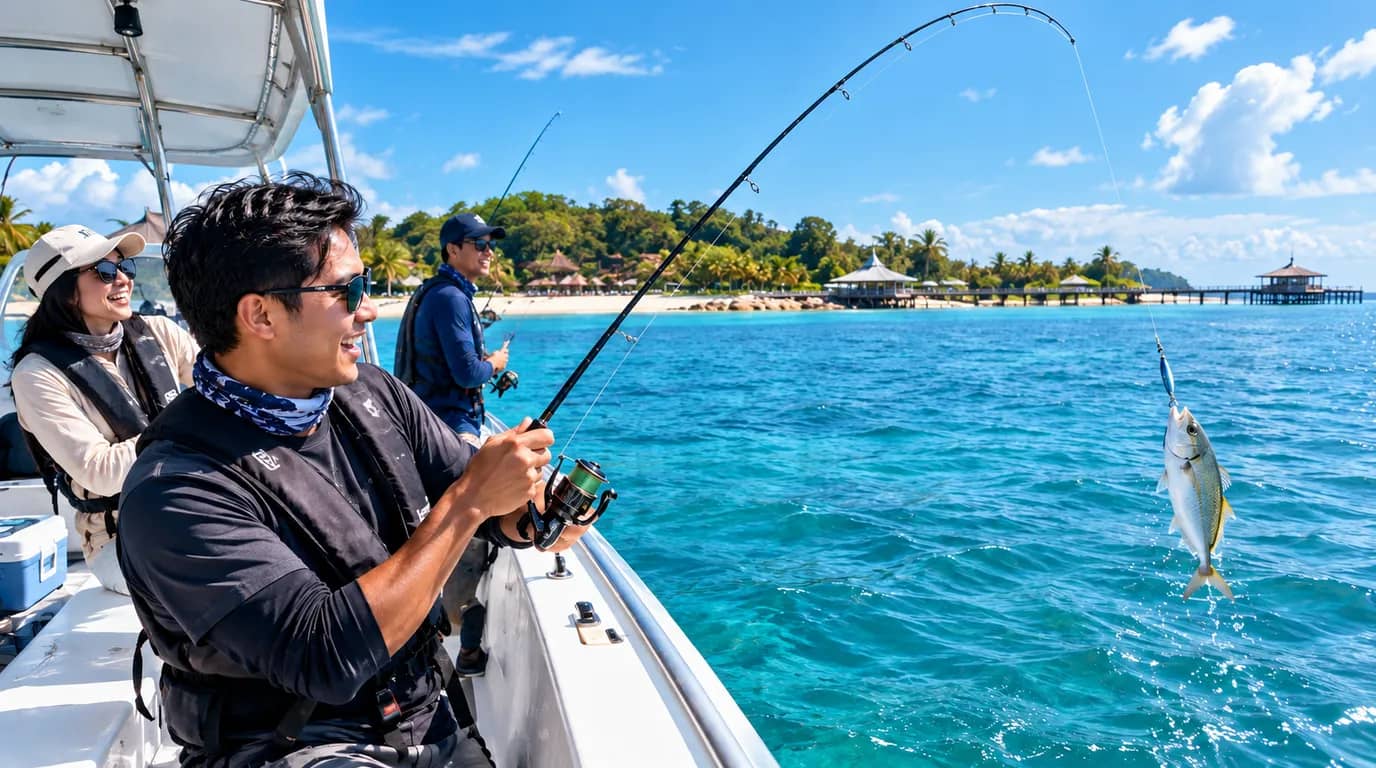
The choice is not about which spot is best, but how far out you want to go. From standing on the sand at Trikora, to a floating kelong that does not sway, to a pompong out to the shallow waters around the islands, all the way to a full-day trip to the Mapur waters, where depths range from several dozen to a hundred metres. These four options differ in almost everything: tackle, departure time, cost and who they suit.
One thing matters more than your choice of trip: the month. From November to February the north wind brings waves in from the South China Sea, and offshore trips are often cancelled the day before or on the morning of departure. What keeps running through those months is shore and kelong fishing. The season section below explains this before you choose a trip.
Departure points, distances and trip lengths
The figures that apply to all four trips below: how long the drive takes, where the boats leave from, how long you spend on the water, and what usually gets caught.
Drive time
60 minutes from Lagoi
45 minutes from Tanjung Pinang
Departure points
Pantai Trikora 4, Teluk Bakau and Kawal harbour — all on the east coast. Each card below shows which trip leaves from where.
Open in Google MapsTrip length
3–10 hours
Shore fishing can be as short as you like. Offshore trips usually leave before dawn and do not return until the afternoon.
Common catches
- Grouper and red snapper
- Spanish mackerel and barracuda
- GT in the Mapur waters
- Cuttlefish and squid at the kelong at night
The right months to go fishing
Bintan does not have a distinct dry and rainy season, but it does have wind seasons. It is the wind, not the rain, that decides whether the boats will risk going out.
Best window
April – October
The calmest seas of the year, and almost every offshore trip runs to schedule. It is also the only sensible window if you are coming specifically to fish and only have a few days — outside these months, one cancelled trip can mean no trip at all.
North wind
November – February
Waves and currents from the South China Sea roll in on the east coast, and offshore trips are often cancelled at short notice — sometimes on the morning of departure, because the decision rests with the skipper, not the schedule. Shore and kelong fishing carry on, which is why both are on this page.
Possible, but check first
March and transition months
The transition months can be excellent or very windy, and conditions can change within days. Trips in these months are best booked with a backup plan: if the offshore trip is cancelled, switch to a kelong or an inshore pompong on the same day.
Four ways to fish in Bintan
Not ranked from best to worst, but by distance: from standing on the sand to waters a hundred metres deep. The trip that suits a family with young children is not the one that suits a GT hunter — and swapping them round works even less well.
Fishing from the beach and jetties
Feet stay on dry land, and you can stop at any time
Fishing from: From land
- Departs from: Pantai Trikora 4
- Drive from Lagoi: 60 minutes from Lagoi
- Depth: 1–3 m
Trikora's coastline stretches for more than ten kilometres and can be fished from the sand, from its granite rocks, and from the wooden jetties of the warung along the road. It is the cheapest and most flexible option: no schedule, no boat to book, and you can stop as soon as the children get bored. The catch is small and unpredictable, but that is not the point — this is a way to spend the afternoon while waiting for the sunset. Simple tackle can be hired or bought at nearby warung.
Target
- Small reef fish among the rocks
- Mullet and mackerel near the sand
- Crabs and prawns in the shallows
Suitable for
Beginners, children and relaxed afternoons
Fishing from a floating kelong
A wooden platform out at sea that does not sway
Fishing from: From a kelong
- Departs from: Teluk Bakau
- Drive from Lagoi: 55 minutes from Lagoi
- Boat time: 10–20 minutes by boat
- Depth: 5–15 m
A kelong is a wooden platform on stilts that fishermen build over the sea, and some now welcome guests. A small boat takes you ten to twenty minutes out from Teluk Bakau, and you fish from the deck with five to fifteen metres of water below. Because it stands on stilts, a kelong does not rock at all — the answer for groups with someone prone to seasickness. Some kelong offer overnight stays, and night is the time for squid jigging: the lamps are switched on, the squid rise to the surface, and it is the part guests remember most. This trip still runs during the north wind season, when offshore boats will not risk going out.
Target
- Cuttlefish and squid at night
- Grouper and snapper beneath the kelong deck
- Reef fish throughout the day
Suitable for
Families, anyone prone to seasickness, and night trips
Bottom fishing by pompong
Twenty to thirty minutes out to shallow waters
Fishing from: From a boat
- Departs from: Pantai Trikora 4
- Drive from Lagoi: 60 minutes from Lagoi
- Boat time: 20–30 minutes by boat
- Depth: 10–30 m
A pompong is a local fisherman's single-engine wooden boat, and hiring one from Trikora is the most common way locals fish here. The boat heads out for twenty to thirty minutes to waters ten to thirty metres deep around the small islands off Trikora, then stops for bottom fishing. It is a sensible middle ground: properly out at sea, yet still within sight of land, and half a day is enough. The boats are basic — usually no toilet and no full roof — so a hat and sunscreen are a must.
Target
- Grouper and red snapper
- Yellowtail and threadfin bream
- The occasional barracuda near the surface
Suitable for
Half-day trips, small groups, beginner to intermediate anglers
Offshore trip to the Mapur waters
One to one and a half hours from Kawal, a full day out
Fishing from: From a boat
- Departs from: Kawal
- Drive from Lagoi: 75 minutes from Lagoi
- Boat time: 60–90 minutes by boat
- Depth: 60–100 m
The most serious trip departing from Bintan, and the reason anglers from Singapore cross over. A larger boat departs from Kawal harbour — not from Trikora, because Kawal is the nearest harbour with boats fit for open water — and travels one to one and a half hours to the waters around Pulau Mapur, which are sixty to a hundred metres deep. Out there it is not just bottom fishing: jigging, popping and trolling are all on, and GT is the most sought-after catch. This is a full-day trip, leaving before dawn and returning in the afternoon, and it is the first trip to be cancelled as soon as the north wind arrives.
Target
- GT (giant trevally) as the main target
- Spanish mackerel and wahoo when trolling
- Grouper and red snapper on the bottom
Suitable for
Experienced anglers; not for young children
Departure points, boat times, depths and drive times were compiled in September 2026 from the trip logs of boat operators in Trikora and Kawal, trip reports from Kepri fishing clubs, the Google Maps entry for each departure point, and charter operators' route descriptions for the Mapur waters. The overland drive times use the same figures as the snorkelling page for the same harbours. This page lists neither boat rates nor tackle hire: boats are hired per boat rather than per person, rates move with fuel prices and group size, and offshore trips are priced differently again. Nor does this page promise a catch — a catch figure is a fact about one morning, not about the waters.
What to prepare before you go
Book well ahead, and have a backup plan
Boats fit for open water are limited in number and fill up fastest from April to October. If you are coming outside that window, agree from the outset what happens if the trip is cancelled because of the wind — a kelong or an inshore pompong is a sensible same-day alternative.
Seasickness tablets, taken before you board
Offshore trips run an hour to an hour and a half to the fishing grounds, then stop and roll with the waves on the spot, and that is the part that makes most people seasick. Take the tablets about an hour before departure, not once you start feeling unwell. If anyone in your group is unsure, the kelong is the answer: the platform stands on stilts and does not sway at all.
Leave in the dark, and eat before you go
Offshore trips usually leave before dawn to catch the morning tide, and from Lagoi that means leaving the hotel at around three o'clock. No restaurants along that route are open at that hour — bring food and water from where you are staying, and make sure you do not skip breakfast.
Ask in advance whether your catch can be cooked
Some seafood restaurants in Trikora and Teluk Bakau will cook the fish you catch for a cooking fee, which is a far better end to the day than carrying fish back to your hotel room. Agree on this before you set off, not after the boat has docked.
We drive you to the east coast, pre-dawn departures included
Tell us the date, the number of people and the type of trip you want. We will prepare the car along with a driver who regularly drives to Trikora and Kawal — including a pre-dawn pickup for offshore trips, and waiting until your boat returns.