

Bintan tourism
Kelenteng Patung Seribu in Tanjung Pinang
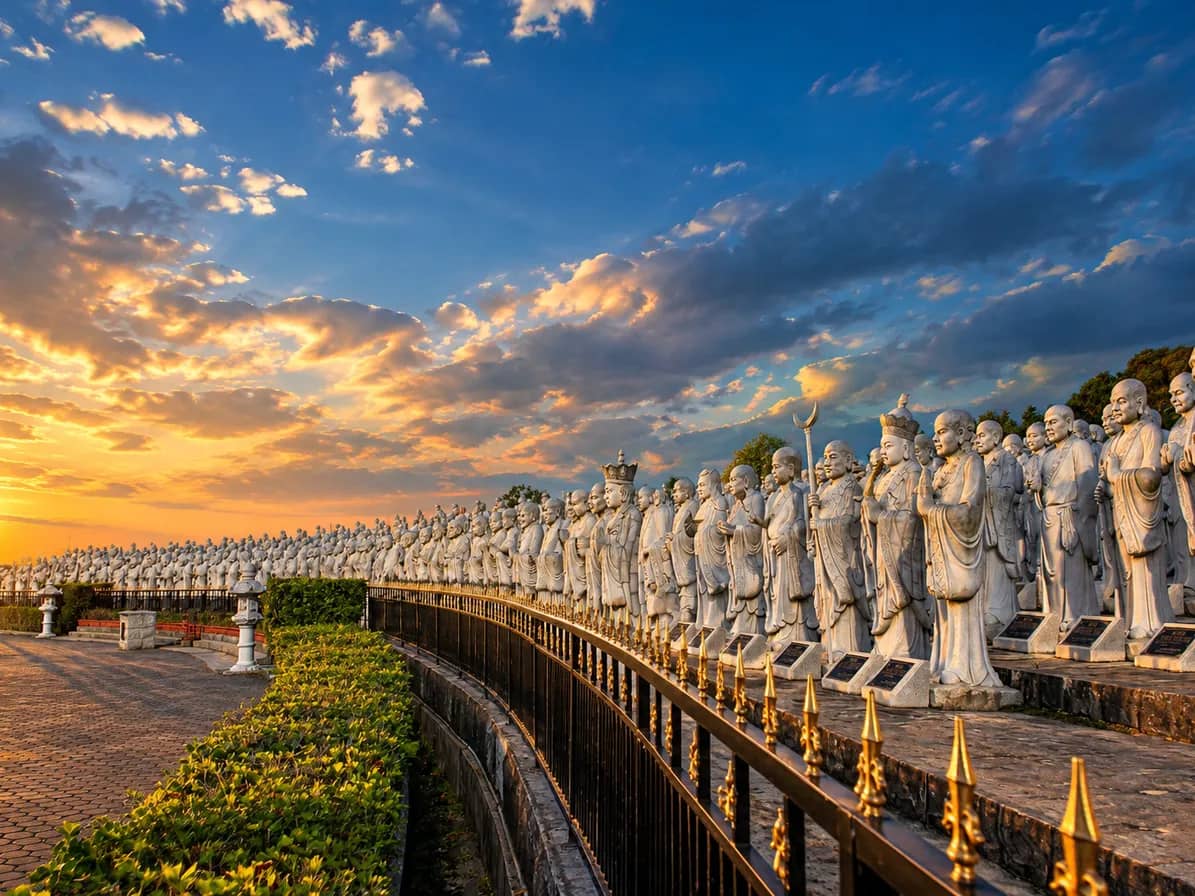
Rows of life-size stone arhat statues climbing a neatly landscaped slope, with a white Guan Yin standing above them — and, on an ordinary day, hardly anyone there. Entry is free. The one thing to bring is an awareness that this is a place of worship, not a monument.
What this place is, and what its two names mean
The name on the gate is Vihara Ksitigarbha Bodhisattva, after the bodhisattva who vowed to empty the hells before accepting buddhahood. The name everyone uses is Kelenteng Patung Seribu — the thousand-statue temple — and the sign at the entrance reads Lohan Temple, lohan being the Hokkien term for arhat, a disciple who has reached the end of the Buddhist path. The statues lining the way up are those arhats, carved life-size in stone, each with a different face and pose.
It is about fifteen kilometres from central Tanjung Pinang, at Air Raja on the Jalan Asia Afrika route — well outside the city and a very long way from Lagoi. The complex is laid out as a landscape rather than packed with buildings: the arhats climb the slope among planting and rock gardens, Guan Yin stands above them, and the main hall sits at the top with a garden and ponds behind it. Nothing here is old — the complex was built within living memory — and nobody pretends otherwise.
One thing to be clear about before you come: this place is still in use. There are people praying in the hall on an ordinary weekday, incense burning, and a community that never asked to become a tourist attraction. Visitors are welcome and entry is free — which is exactly why the etiquette section at the bottom of this page is the part most worth reading.
Location, opening hours and cost
The four things people look up first. Drive times are given from Tanjung Pinang first, because this is the only place on our tourism pages that is closer to the city than to the resort area.
Drive time
20 minutes from Tanjung Pinang
70 minutes from Lagoi
Visiting hours
08:00–17:00, daily
These are the hours the complex is open to visitors. The main hall keeps its own hours and closes earlier on certain days, and on festival dates the whole complex runs on a completely different schedule — see the calendar below.
Entry fee
Free, and so is parking. There is a donation box inside the hall, and nothing is asked of you at any point. If you would like to give something, put it in the box — do not hand it directly to anyone.
City
Kota Tanjung Pinang
Address: Jl. Asia Afrika KM 14, Air Raja, Tanjung Pinang Timur, Kota Tanjung Pinang, Kepulauan Riau 29125
Open in Google Maps
Your date matters more than the time of day
The complex looks much the same at ten in the morning as at four in the afternoon. What really changes a visit is the date — this is an active temple, and a few times a year it is anything but a quiet hillside.
Most of the year
Ordinary days
Quiet enough that you will often have the rows of statues to yourself, with a few people in the hall and someone sweeping. This is the face of the place you see in photos, and what to expect unless your dates fall within one of the two periods below. Weekday mornings are the quietest; Sunday afternoons start to fill with local families.
January–February
Imlek and Cap Go Meh
Chinese New Year and the two weeks that follow, up to Cap Go Meh, are when the temple is at its fullest and liveliest: lanterns hung, offerings piled high, a steady stream of people. Worth seeing if you happen to be here — and the wrong time if you are after a quiet stroll with a camera. The car park fills up, the approach road gets congested, and photographing people at prayer is clearly inappropriate.
May, and July–August
Waisak and the seventh month
Waisak in May and the seventh month of the Chinese lunar calendar in July or August both bring ceremonies and a busier hall — especially the seventh month, when offerings are made to wandering spirits and the complex stays busy into the night. Not as crowded as Imlek, but more clearly a time of worship. Visitors are not turned away, but these are days to stand at the back.
What is in the complex
In the order you walk it: up past the rows of arhats, past Guan Yin to the hall, then down through the garden to the terrace where you look back. Half an hour is enough, an hour if you linger.
The rows of arhat statues
Life-size stone statues on both sides of the path up
The reason for its popular name: rows of stone arhats stand along the path climbing from the gate, each carved at roughly life size and no two alike — one holding a scroll, one laughing, one with a tiger, one with eyebrows trailing down to his chest. They are spread along the slope rather than crammed together, with planting and rock gardens in between, so the walk up is the point, not just a way to reach the top. Nobody agrees on how many there are, and the note below this list explains why.
Good for: Everyone; this is why you come
The Guan Yin statue above the arhats
The white figure watching over the whole hillside
A tall white statue of Guan Yin — Kwan Im, the bodhisattva of compassion — stands on the level ground above the rows of arhats, with rock gardens and planting built around her base. She is the first thing you see from the main road and the figure that anchors the photo from below, because everything on the slope faces towards her. There is room to stand at her feet, and some people do come specifically to pray rather than to look around.
Good for: Everyone; people may be praying — give them space
The main hall
An active place of worship at the top of the climb
Red pillars, a tiled roof with dragons along the ridge, and the Lohan Temple sign above the door. Inside are the altars, incense and whoever happens to be there that day, and this is the part of the complex that plays the tourist attraction least: it is where the community actually worships. Shoes off where requested, phones on silent, cameras down if anyone is at the altar. Step inside, stand at the back, and leave once you have seen enough.
Good for: Anyone willing to observe the etiquette
The garden and ponds
Rock gardens, sculpted trees and koi behind the hall
Behind and below the hall, the grounds are laid out as a Chinese garden: shaped rocks, pruned and potted trees, a pagoda, and ponds of koi that will hold children's attention longer than anything else here. It is the quietest corner of the complex and the one most often missed, because most visitors turn back at the hall. Ten minutes — and it is the only shaded part.
Good for: Children, and anyone wanting ten minutes in the shade
The terrace and the view down
All the rows of statues in one frame, from above
From the level ground near the hall, the path and the rows of arhats stretch out below you with the plains behind — the only spot here that shows the shape of the whole thing rather than just the statue in front of you. The light is also best in the late afternoon, when the sun comes across the slope from the side and the stone stops looking flat. Head down this way rather than back along the path you came up.
Good for: Photos, and the last stop before you leave
Addresses, hours and drive times were compiled in September 2026 from the temple's Google Maps listing, the Dinas Pariwisata Kota Tanjung Pinang destination list, and our drivers' trip logs. Hours change on festival dates, and the main hall keeps its own hours. This page does not give a statue count: the popular name says a thousand, the figure usually published is around five hundred, and none of the sources we checked agree with each other — so this page describes what is there rather than picking one number to repeat. Festival periods are given as months rather than dates because the lunar calendar shifts them every year; check before planning around them.
Etiquette here
Cover shoulders and knees
Both, for everyone, including children old enough to be told. Plenty of visitors arrive straight from the beach in sleeveless tops and shorts and are still let in — that does not mean it is appropriate. Keep a shirt in the car if your day starts on the coast.
Do not climb on or pose with the statues
The arhats are not photo props. Standing beside one is fine; sitting on one, hanging off it or arranging a group around it is what gets visitors asked to leave, and it is the complaint the caretakers raise most often. The same applies to the Guan Yin statue.
Ask before photographing people
The complex is open to cameras; the people in it are not. If someone is at the altar, making an offering or lighting incense, lower your camera — and if you still want the shot, ask permission first and accept it if the answer is no.
Keep quiet in the hall, and stay on the paths
Shoes off where requested, phones on silent, and no eating or drinking anywhere in the complex. The planting between the statues is someone's hard work and not for walking on. If an area is roped off, there is a reason, and nobody will stop to explain it.
An hour from Lagoi — we will take you there and back
Tell us the date, how many of you there are and where to pick you up. Our drivers know the Air Raja turn-off, and this stop fits easily into a Tanjung Pinang day together with Penyengat and the waterfront.